
How to Tell If Your Attic Insulation Was Installed Correctly
When most homeowners think about what makes a roof last, they think about shingle quality, contractor workmanship, or how often they schedule inspections. Roof pitch — the steepness of the slope — rarely comes up in those conversations. But pitch is one of the most fundamental factors in how a roof performs over its lifetime, and in Illinois’s climate, it plays a direct role in how well your roof handles everything from heavy snow to spring thunderstorms.
At Swiftguard Enterprises LLC, we work on roofs of all pitches throughout Oak Lawn, IL and the greater Chicagoland area. Here’s what homeowners need to understand about how slope affects their roof’s durability, drainage, and long-term performance.
Roof pitch is expressed as a ratio of rise to run — the number of inches a roof rises vertically for every 12 inches of horizontal distance. A 4/12 pitch rises 4 inches for every foot of run. A 12/12 pitch is a 45-degree angle. Roofs are generally categorized as:
Each range has its own performance profile, and each responds differently to the specific weather patterns Illinois homeowners deal with every year.
The most direct impact of roof pitch is on how quickly water and snow leave the roof surface. Steeper roofs shed precipitation faster — water runs off quickly, and snow slides before it can accumulate significant weight. Lower-slope roofs hold water longer at every stage of a rain event and allow snow to build up.
In Illinois, where annual snowfall in the Chicagoland area averages 30–40 inches and spring rain events can be intense, drainage speed matters. A roof that drains slowly is a roof that’s in contact with moisture longer — and that extended contact accelerates shingle deterioration, increases the risk of ice dam formation, and puts more stress on the underlying structure.
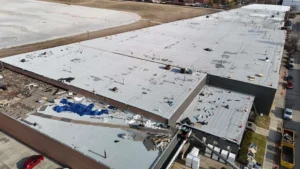
For low-slope roofs, this is why membrane systems like TPO and EPDM exist — asphalt shingles are not rated for pitches below 2/12 because standing water will infiltrate the overlapping shingle joints. Conventional-slope roofs drain well enough for standard architectural shingles, while steep-slope roofs drain fastest of all.
Ice dams are one of the most damaging winter roof problems in Illinois, and pitch is directly connected to how and where they form. Ice dams develop when heat escaping from the living space warms the upper portion of the roof, melting snow that then refreezes at the cold eaves where there’s no heat below.
Steeper roofs tend to shed snow before it can build up enough mass to create serious ice dam conditions. Lower-slope roofs hold snow longer, giving it more time to go through the melt-refreeze cycle that produces ice dams. That said, pitch alone doesn’t prevent ice dams — attic insulation and ventilation are equally important factors. A steep roof with inadequate ventilation can still develop ice dams, while a well-insulated and ventilated lower-slope roof may not.
What pitch does affect is the scale and speed of snow accumulation, which sets the stage for everything else.
Asphalt shingles — the most common roofing material in Illinois residential construction — are designed and warranted for use within specific pitch ranges. At very low slopes (below 4/12), standard shingle installation requires additional underlayment and modified installation techniques to compensate for slower drainage. At pitches below 2/12, shingles aren’t appropriate at all.
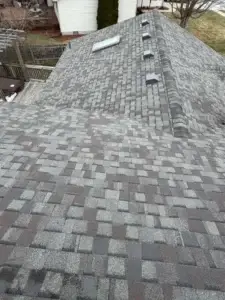
Within the conventional slope range, steeper pitches generally allow shingles to perform at the upper end of their rated lifespan. Water exits the surface faster, UV exposure is more evenly distributed, and debris is less likely to accumulate in ways that trap moisture. Lower conventional slopes (around 3/12 to 4/12) perform adequately with proper installation but may see slightly shorter effective lifespans due to longer moisture contact time.
Steep-slope roofs present their own considerations — installation is more labor-intensive and safety requirements are more demanding, which affects both initial cost and the cost of future maintenance and repairs.
Illinois is no stranger to high winds, particularly during spring and summer storm systems that push through the Chicagoland area. Roof pitch affects how wind interacts with the structure in important ways.
Lower-slope roofs present less surface area to the wind but can be more vulnerable to uplift forces — wind traveling across a flat or near-flat surface creates negative pressure that can lift the membrane or shingles. Steeper roofs present more surface area to the wind but deflect it more effectively, reducing uplift at the eaves.
For most Illinois homes in the conventional pitch range, wind performance comes down more to proper shingle fastening, starter strip installation, and drip edge detailing than to pitch alone. Where pitch becomes a significant wind factor is at the extremes — very low-slope roofs in high-wind areas and very steep roofs that present a large sail surface to strong directional winds.
Roof pitch also affects how easily a roof can be inspected and maintained. Conventional-slope roofs in the 4/12 to 7/12 range are accessible to experienced roofing professionals and allow thorough hands-on inspection of the entire surface. Steep-slope roofs above 9/12 require additional safety equipment and take more time to work on safely, which is reflected in inspection and repair costs.
Low-slope roofs are often walkable but require careful attention to the membrane surface — foot traffic on an aging membrane can cause damage that wouldn’t affect a shingle surface.
Regardless of pitch, the recommendation for Illinois homeowners is the same: schedule professional roof inspections after significant storm events and at least once every one to two years as the roof ages. Pitch affects what the inspector is looking for and how they access the surface, but it doesn’t change the importance of regular assessment.
If you’re planning a roof replacement, understanding your existing pitch matters for material selection, installation costs, and long-term performance expectations. A roofing contractor should always account for your specific slope when recommending materials, underlayment specifications, and installation methods — a one-size-fits-all approach doesn’t serve roofs at the lower or upper ends of the pitch range.
At Swiftguard Enterprises LLC, we assess each roof based on its specific pitch, the Illinois climate conditions it faces, and the homeowner’s goals for longevity and performance. Whether your home has a low-slope section, a conventional gable, or a steep architectural slope, we provide the right materials and installation approach for your specific roof.
Ready for a professional roof assessment? Contact Swiftguard Enterprises LLC today to schedule your inspection and get expert guidance for your Oak Lawn, IL home.

With 15 years of experience, we are committed to delivering high-quality workmanship, dependable service, and long-lasting results.
We don’t just build and repair — we protect what matters most.